Coordinating Financial Transfers with Status Elevations in Real-Time Dealer Sessions via Portable Applications
Written by Kai Friedrich · May 30, 2026
Coordinating Financial Transfers with Status Elevations in Real-Time Dealer Sessions via Portable Applications
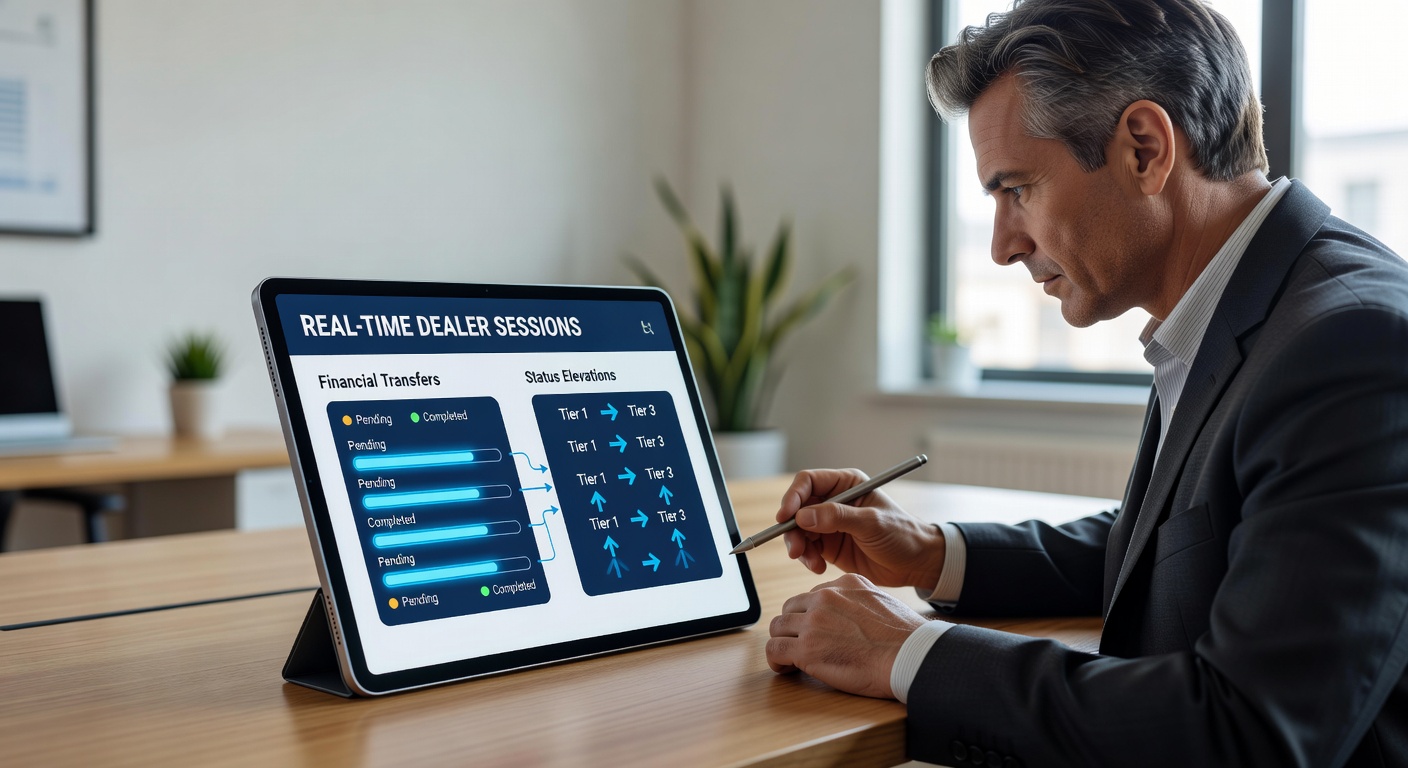
Portable applications now integrate payment processing directly with loyalty tracking systems during live dealer sessions, allowing account balances and status levels to update without interrupting gameplay. Developers achieve this through synchronized APIs that connect banking gateways to casino management platforms, so deposits register instantly and trigger tier advancements mid-session.
Systems operate by monitoring transaction confirmations alongside session metrics such as hands played and wagers placed. When a player completes a qualifying deposit, the application recalculates eligibility for higher tiers and applies corresponding benefits like reduced rake or priority seating before the next round begins. Observers note that this coordination reduces latency compared to earlier batch-processing methods that delayed rewards until session end.
Core Mechanisms in Mobile Live Dealer Environments
Real-time coordination relies on several layered components. Payment processors transmit authorization codes to the central server within milliseconds, while the loyalty engine evaluates cumulative activity against predefined thresholds. Status elevations occur automatically once criteria are met, and the application pushes notifications to the player's device alongside updated balance displays.
Technicians design these flows to handle concurrent users across multiple tables. Data centers route requests through load-balanced channels, and encryption protocols protect both financial details and account identifiers during transmission. Industry reports indicate that such integrations have become standard in platforms supporting high-volume live dealer traffic since 2023.
Payment and Loyalty Synchronization
Developers map specific transaction types to status actions through configurable rulesets. A deposit exceeding a set amount, for instance, advances a player from bronze to silver tier and unlocks immediate access to private tables. The application records each elevation with timestamps, enabling audit trails that regulators review during compliance checks.
Withdrawals also interact with status systems, though operators typically freeze tier progress during pending cash-outs to prevent simultaneous conflicting updates. This safeguard maintains data integrity across sessions that span multiple hours.
Research from gaming technology firms shows average session durations increase when players receive instant tier feedback, because visible progress encourages continued participation. Portable applications display progress bars and upcoming rewards directly on the live table interface, keeping attention focused on the dealer feed rather than separate account menus.

Implementation Across Regional Markets
Operators in North America adopted these coordinated systems earlier than many European counterparts, driven by state-level licensing requirements that emphasize transparent player tracking. Canadian provincial regulators have examined similar frameworks, noting that real-time updates help verify responsible gaming limits without manual intervention.
Australian jurisdictions require documented evidence that status changes align with deposit records, and portable applications satisfy this through automated logs that export directly to oversight portals. European operators meanwhile focus on cross-border compatibility, ensuring that currency conversions and regional payment rails do not disrupt status calculations during international sessions.
According to documentation released by the Nevada Gaming Control Board, platforms must demonstrate that financial transfers and loyalty adjustments occur within defined time windows to maintain operational approval. These standards have influenced development roadmaps for several major software providers.
Technical Standards and Security Protocols
Application programming interfaces follow PCI-DSS guidelines for payment handling while incorporating additional checksums that verify status calculations match recorded activity. Multi-factor authentication occurs at login and again before large transfers, yet once a session starts the system permits seamless elevation without further prompts.
Cloud-based architectures allow operators to scale during peak evening hours when live dealer tables reach capacity. Redundant servers mirror transaction and status data across geographic regions, reducing the risk of desynchronization if one node experiences latency. Security audits conducted quarterly confirm that encryption keys rotate automatically after each elevation event.
One documented case involved a platform that linked instant bank transfers to tier progression in under two seconds, a benchmark now referenced in technical specifications shared among developers. Such performance metrics guide procurement decisions when operators upgrade existing mobile infrastructure.
Outlook Toward Mid-2026
Industry analysts project expanded adoption of 5G-enabled devices will further compress transfer and elevation times by May 2026. Updated hardware supports higher-resolution live streams without draining battery life, allowing sessions to extend while the background coordination continues uninterrupted.
Regulatory bodies in several jurisdictions plan to introduce standardized reporting formats for real-time loyalty data by that period, which would simplify cross-platform verification. Software vendors are already preparing modular updates that accommodate these forthcoming requirements without requiring full system replacements.
Conclusion
Portable applications have established reliable pathways that align financial movements with loyalty advancements inside live dealer environments. Continued refinement of APIs and security layers supports consistent performance across expanding user bases and regulatory landscapes. By May 2026, further infrastructure improvements are expected to maintain these coordinated functions at even higher volumes.